Book Launches for The Garbage Poems

Here’s the list of places I’ll be reading and launching the book this fall. I’ll update dates and venues as they’re confirmed!

WOODY POINT, NL: August 21st: Writers at Woody Point Reading, 4pm, Merchant Warehouse, Free

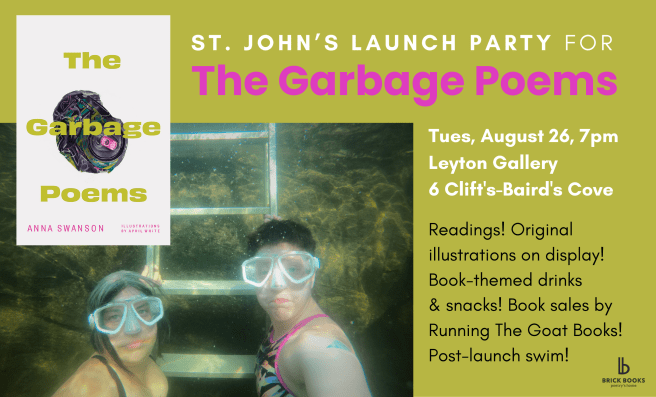
ST. JOHN’S, NL: August 26th: St. John’s Launch at the Leyton Gallery, 6 Clift’s Baird’s Cove, 7pm, Free

TORONTO ISLANDS, ON: September 13th – Canoe Paddle + Reading on Toronto Island, 2pm (Free but registration required)

GUELPH, ON (Individual Launch): September 16th, 6:30 – Guelph Backyard Book Launch (Exhibition Park Area) Register for details

GUELPH, ON (Group Launch/Show): October 16th, 7pm – Poetry @ Silence: with Charlie Petch, Anna Swanson, Lisa Baird, & Ziysah von Bieberstein, doors 7pm, show 7:30, Venue: Silence, 46 Essex St, Guelph, ON, by donation. Eventbrite | Facebook | IG

TORONTO, ON: October 17th, 7pm – Toronto Launch at Another Story Books with Charlie Petch, Qurat Dar, M’yz. and hosted by Alayna Munce, Free. Eventbrite | Facebook | IG

MONTREAL, QC: October 19th, 7pm, Lamp Lit Reading Series, with April White, Nels Penney, Veronique Synott, and Calypso Andrew, (for address DM the host at this link or contact me directly), by donation.

VICTORIA, BC: October 26th – Victoria Launch with Michael V. Smith, Kate Braid and Emmett MacMillen, The Paul Phillips Hall, 1923 Fernwood Road, Doors 6:30, show 7pm, free. Facebook | IG

VANCOUVER, BC: October 29 – Vancouver Launch with Amber Dawn and Estlin McPhee, Oct 29th, Iron Dog Books, 2671 East Hastings St, Vancouver, Free. Register | Facebook | IG

WHISTLER, BC: November 2, 9:00  – 10:15 a.m – Whistler Writers Festival, Finding Our Way: Salish Stroll Forest Walk, Meeting Point: Fairmont Chateau Whistler, $27. Get Tickets | IG.
And… we have a cover!

ID: Book cover for The Garbage Poems by Anna Swanson. Illustrations by April White. Light grey background with a gouache painting of a dark grey crushed can with teal, light green, and hot pink highlights. The title is a muted green with author/illustrator text in hot pink.

I’m so thrilled to finally be able to share the cover design for The Garbage Poems, coming out from Brick Books in September. Design by Natalie Olsen of Kisscut Design with art by April White.

You already know I’m wild about April’s art, but I’m also a big fan of Natalie’s design and book covers (she’s done many of my favourite book covers). When I was asked to provide examples of poetry book covers that I liked, we realized after the fact that there were several of hers at the top of the list, entirely by accident. You might also know her via the gorgeous short story advent calendar she publishes (as part of Hinston & Olsen), which I got to enjoy for the first time this past year.

I’m thrilled that she’s doing the design for the whole book and I can’t wait to see what she does for the interior!

Opaat Press Pamphlet

I am so honoured to have one of my poems included in this year’s round of Opaat micropress pamphlets! My poem, “Blessing for the Matzah,” was written at this time last year for use in a local community Seder and connects the story of Passover to the current day genocide ongoing in Gaza. Passover will not be a feast of freedom until we can celebrate a freedom for all, including a Free Palestine. A heartfelt thank you to Annick MacAskill for including this poem. And how wonderful to be in such fantastic company – I can’t wait to read them all!

[ID: Five card stock poem pamphlets in different colours on a round wooden stool or table. Image above from the Opaat Press Listing on Annick MacAskill’s website.]

Blessing for the Matzah & Liberation Haggadah Resources

I wrote this poem/blessing trying to understand Passover in this time of genocide. After a recent online event where I read it, several people contacted me to ask for a copy to read at their family or Community Seder. I wanted to offer it to anyone who finds it meaningful for their Seder this year (as long as it’s not for commercial use).

See below for some liberatory Hagaddah resources. Poem below, or click here for PDF.

Free Palestine.


Blessing for the Matzah        

[One speaker reads, with the rest of the group joining in on the bold text]

We realize again in each generation
that we did not truly understand what it meant,
the bread of affliction.

From long tables of borderless plenty,
our beautiful futures look back in sorrow
for they have reached that part of the story.

We must tell it as if we were there.
We were there.

We watched on our phones
as parents ground animal feed and baked it into hard loaves.
We saw the blood-soaked sacks of flour
in the streets.

We hold this matzah up,
bread of affliction, bread of liberation,
reaching back into story and then
forward into prayer,

into the late-afternoon streets
where a child runs with cousins
through the market, past cardamom,
cumin, turmeric, nutmeg, past strawberry stands
and bakeries and boats bobbing
in the open port, past birds and fruit trees
and doors built back around every key.
 
Into a world where the dead rest easy,
their names busy among the living,
blossoming into schools, libraries,
street signs, hospital wings
across a free Palestine.
 
May we be the ancestors
of a better story.
 
Amen.


Liberation-oriented Haggadah resources

In “Hearkening to the Voice of Gaza: Seder Readings for Passover 5784” from Chicago Tzedek, we are reminded that “As we lift up the matzah this Passover, the words of Palestinian poet Mosab Abu Toha remind us that for Gazans experiencing forced starvation, lechem oni – the bread of affliction – is more than merely symbolic.”

Three days later, on social media, (my brother) Hamza posted a photograph of what he was eating that day: a ragged brown morsel, seared black on one side and flecked with grainy bits. “This is the wondrous thing we call ‘bread’—a mixture of rabbit, donkey, and pigeon feed,” Hamza wrote in Arabic. “There is nothing good about it except that it fills our bellies. It is impossible to stuff it with other foods, or even break it except by biting down hard with one’s teeth…”

There are many great liberation-oriented Haggadah resources, including many new ones this year like the one quoted above. The most expansive list I’ve found is here (8 pages of links!):

Justice-y Passover Seder Haggadot/Supplements ✊🌾🐸🧿

A few liberation Haggadah resources that are new this year:

[NEW] From the River to the Sea: A Passover Haggadah by Families for Ceasefire Philly 5784/2024 (great for children and families)

[NEW] Harkening to the Voices of Gaza from Chicago Tzedek (a Haggadah supplement with readings from Gazan writers that fit each section of the Seder)

[NEW] Pillar of Fire Haggadah: A collective queer anti-zionist haggadah

[NEW] JVP (Jewish Voice for Peach) Passover 5784/2024: Exodus from Zionism

[NEW] If Not Now Freedom for All Haggadah

Hightlights from recent years (these, plus some of the new ones above, are some of the sources I used when piecing together a Haggadah for my own use):

Legacies of Resistance: An Anti-Zionist Haggadah for a Liberation Seder by the International Jewish Anti-Zionist Network (IJAN)

Jewish Voice For Peace Haggadah 5777

Passover Toolkit 5775 (2021): Set the stage for the telling The Great Narrative of Liberation by Rabbi Lynn Gottlieb for the Jewish Voice for Peace Rabbinical Council

Kavod Jews of Color, Indigenous Jews, Mizrahim, & Sephardim Caucus Haggadah 2019

JUFJ Jews United for Justice Social Justice Seder 2020

Love and Justice in the Time of War Haggadah/Zine by Micah Bazant and Dara Silverman’s 

About the Spoon on the Seder Plate: 

Pesach Resource Library collected by Cleveland Jewish Collective

Interesting historical Haggadot:

The Israeli Black Panthers Haggadah 50th Anniversary Edition

Hagode shel Peysekh (with a Socialist Twist): A partial translation of a 1919 Socialist Haggadah published by the Galician Bund

But seriously, there are so so SO many more. Check out the list above. And we’ll keep writing them every year until everyone is free.

CBC Poetry Prize Shortlist

I am so pleased and grateful that my poem “Sweetness | מתיקות” was shortlisted for the 2023 CBC Poetry Prize. It’s a dissonant feeling to try to celebrate a good thing in this time of daily violence and genocide, but I’m glad it’s a poem which calls in various kinds of sweetness including the sweetness of solidarity, of standing together in the streets with thousands of people and shouting for the world we want to make together. And while it obviously wasn’t written for this moment, I’m glad it happens to be a poem which, even if only in passing, squished between queer sex and brisket for forty in the backyard, shouts out Free Palestine. May the small sweetnesses sustain us so that we can keep showing up in solidarity to build a world based in collective liberation.

I did do some interviews about the poem and the shortlist, but the one which ended up posted online wasn’t a great experience for me so I don’t want to share that one here. Instead, I’ll share what I wrote (in a daze in the middle of last October) as part of my answer to the shortlist questionnaire that was never used:

This year, for the two weeks around Rosh Hashanah, I had the beautiful and bewildering experience of feeling like I was living in this poem. Not just generally, but in some pointedly specific ways. New friends, a wild series of “pleased to inform” emails, an all-day honey harvest, marching in the streets yelling Protect Trans Kids (though I had hoped we would not need to do that again so soon). One of the moments was at a Rosh Hashanah gathering, in the new town I’d only just moved to, with a backyard full of queers and kids and beekeepers and singing and honey rituals and a blessing for gender autonomy and someone in a Free Palestine t-shirt blowing the shofar and too much food and people balancing plates on their laps and last-minute forks from the thrift store. At some point, as various lines from the poem played out around me, I looked over at my dearest friend (who had helped me edit the poem from several provinces away and who is now my neighbour again for the first time in a decade) and said, Does it kind of feel like…? and she laughed and said, Yes, obviously.

When I submitted this poem last Spring, I wanted to wish us all some sweetness for this coming year, during a time that hasn’t been particularly easy. As I write this, in the midst of the unfolding news in Gaza over the past few weeks, my heart is breaking in so many directions. I don’t know how to look away from the horror of the daily news. I don’t know how to grieve without fear that my grief will be weaponized against Palestinians. I don’t know how to make the violence stop, and I don’t know how to focus on anything else either. I remind myself that solidarity is a kind of sweetness, that we do not stand alone, that another world is possible. May we see a Free Palestine in our lifetimes.

New poems in Rogue Agent

Did I write a series of manifestos in the voices of my mortal enemies? Why, yes I did. In this case: Insomnia. It was a weird exercise in attempting some kind of imaginative empathy for entities that have made my life miserable. (But also, did a single night of insomnia make me gay? Yes, yes it did.)

The weird little insomnia poem that came out of this has found a perfect home in Rogue Agent and I couldn’t be more pleased. If you are interested in where poetry and bodies meet, check this journal out. It’s always got engaging and visceral work, and this issue is no exception.

Impact anthology on CBC list of best Canadian 2021 non-fiction

So delighted to see an anthology I have been a part of (Impact: Women Writing After Concussion, University of Alberta Press, 2021) on this list! It is impressive company indeed–so many great books on there.

https://www.cbc.ca/books/the-best-canadian-nonfiction-of-2021-1.6276723

The essay I wrote for the anthology is called “In Which Skinny Dipping Temporarily Fixes a Life.” It talks about how my concussion affected my life and my mental health and my writing, and how my writing process for the Garbage Poems project came out of that.

The editors worked with filmmaker Junyeong Kim to create a series of book trailers for the anthology, each focused on a different theme. My essay, not surprisingly, is in the “I Dream of Swimming” section. Here’s the trailer for the essays in that section:

Check out the whole reel of trailers here: https://www.youtube.com/playlist?list=PLCiHkBuv_jWYTc064OeLoAf08FnOSm1bJ

And more about the book here: https://www.uap.ualberta.ca/titles/1017-9781772125818-impact

It’s really quite a book – devastating, moving, and relatable even thought the experiences range so widely. I was honoured to see my essay keeping such amazing company in the pages of this book.

The Canthius Pleasures Project

Illness and joy have had a strange and often fraught relationship in my life. My sickest years in my twenties, when I had to stop working and attending classes for several years, were also the time I came out and discovered writing. When I was on medical leave a couple of years ago, swimming outdoors was a balm when I could work myself up to leaving the house. But I lived in constant worry that someone would see me doing something fun and think I should be back at work already.

It has been hard for me to hold the simultaneity of illness and joy without making it an either/or, and even harder to trust that other people will do the same. It has been hard for me to remember that I deserve rest and pleasure outside of the frame of ‘earning’ them—either by being so sick I have to be in bed, or by being productive enough that I can see them as rewards.

I’m so happy two poems from the Garbage Poems have found a home in the Canthius Pleasures Project, especially Blessing for the swim selfie which is the most directly I’ve written about illness and joy. This eclectic online project explores pleasure from a feminist and intersectional perspective, and I am LOVING it so far – I adore reading about the why and how of artists’ processes when writing and creating about pleasure. I can’t wait to make my way through the rest of it.

With thanks to April White for their illustration work for the ongoing project, and for the underwater swimming selfie research (which I used to call “research” with scare quotes because how could research be fun?) which profoundly altered my ability to look at images of my own body with pleasure or interest instead of fear.

[Image ID: Photograph of a laptop and keyboard on a wooden desk, surrounded by carefully arranged rows of garbage including cans, bottles, chip bags, cigarette boxes, cups, and bottle caps.]

I am writing a spell for your nervous system

This year’s Sparks Literary Festival was cancelled once during our Snowmageddon State of Emergency this January, and rescheduled for late March. We all know how that turned out. The festival is wonderful, and it’s one of many recent cultural losses. I’d entirely forgotten about the associated poetry contest until I got the email saying I’d won first place. I was more moved than I probably should have been. I think I’d forgotten that unadulterated good news existed. Congratulations also to Grant Loveys and Maggie Burton. Sparks asked for a video of the poem to post, so my artist friend/collaborator April White and I worked together to create this video. Which is to say, I had an idea, and then she jumped in and actually made this beautiful thing. Thank you April. The poem was written during an entirely different time, but it feel eerily relevant right now. ❤

Or view video on Vimeo here. Text in the video is the poem below.

I am writing a spell for your nervous system

and hiding it in a poem.
I know you’re trying to stitch

the world back together
while it breathes and keeps

breaking. Like you. Another
heatwave, hurricane. Grief

gurgles like a sump pump.
The arctic on fire. Thirsty birds

of industry, mouthing
dry wells. Bulldozers

in the olive grove. Prehensile
suits in a sealed building,

deciding who deserves
to be a person. Baby monitors

tuned to the evening news.
Geologic time is breathing

hard. Your nerves: clenched
shut like barnacles and still

flinching. I am casting a road
out of the city. Stop waiting

for CNN to self-soothe.
Stop memorizing formulas

for herbal abortion, just
in case, even though

some futures are no longer
unimaginable. Here

is a highway that vanishes
behind you like wet footprints.

Gravel pullout, the rule
of three boulders across

an unmarked road. The car door
closing with a reverse bang,

retracting into itself
the existence of cars.

Because you are in a poem,
rusted mile-markers appear

only for as long as you walk
the dirt road towards them.

Now a marshy spot, now
lily pads, now wooden pallets

thrown down for you to cross.
Labrador tea and pitcher plants

flanking a narrow trail, and
wasn’t it ever only this?

An opening in the trees.
Worn stones sloping down

to the flickering mirror of a pond.
Step out of the idea of clothes,

into a shallow dive.
Fingertip-to-fingertip

with your reflection—and
gone. A beat later, slick

and blinking, as if from a dark
room: somersault, scissor kick,

glide. Your body diamond-tipped,
a stylus polishing a groove.

Practice this skin. A dark map
back here, sparking, neural.

When it is time, walk up out
of the pond, dripping with

what made you. The world
leans down over cupped palms

to blow you dry. When you are
ready for clothes to exist,

clothes. The path winks
into existence before you.

Eventually you think,
I had a car. Onward,

the messy heartbeat
of the world. And whatever

work you have to do,
you begin again.